

Most people assume a security incident means a hacker broke in and stole data. That assumption causes real problems. A failed login attempt is not a security incident. Neither is every phishing email that lands in an inbox. Knowing what is a security incident, precisely and technically, determines whether your organization responds correctly, reports appropriately, and recovers quickly. Get the definition wrong, and you either overreact to noise or miss the signal that matters most.
Table of Contents
- Key takeaways
- What is a security incident: definition and key distinctions
- Common types and causes of security incidents
- Implications of a security incident for organizations
- How to handle a security incident
- Real-world scenarios that illustrate the difference
- My take on why incident classification gets mishandled
- Build your incident response skills with Cybercoreacademy
- FAQ
Key takeaways
| Point | Details |
|---|---|
| Events are not incidents | Every incident starts as an event, but fewer than 5% of security events escalate into actual incidents. |
| Three pillars are at stake | A true security incident threatens confidentiality, integrity, or availability of systems or data. |
| Classification drives response | Misclassifying an incident as a breach, or vice versa, creates legal and regulatory exposure under GDPR and HIPAA. |
| Human error dominates causes | 62% of breaches involve a human element, making training and awareness the most direct prevention tool. |
| Preparation beats improvisation | Organizations without a documented incident response plan consistently amplify damage when incidents occur. |
What is a security incident: definition and key distinctions
The formal security incident definition comes from NIST SP 800-61 Rev 3, which describes a security incident as a violation or imminent threat of violation of computer security policies, acceptable use policies, or standard security practices. That definition is precise for a reason. Not every anomaly qualifies.
A security event is any observable occurrence in a system. A login, a file transfer, a configuration change. These happen thousands of times a day. A security incident is a security event that violates policy or threatens the confidentiality, integrity, or availability of information. The CIA triad is your filter. If an event does not touch one of those three pillars, it is not an incident.
A breach is a step further. A breach means unauthorized parties have actually accessed protected data. The distinction matters enormously because fewer than 5% of incidents ever escalate to that level. Most incidents are contained before data leaves the organization.
Here is how the three terms compare:
| Term | Definition | Example |
|---|---|---|
| Security event | Any observable system occurrence | User logs in from a new device |
| Security incident | Event that threatens CIA triad or violates policy | Malware detected on a workstation |
| Data breach | Confirmed unauthorized access to protected data | Customer records exfiltrated to external server |
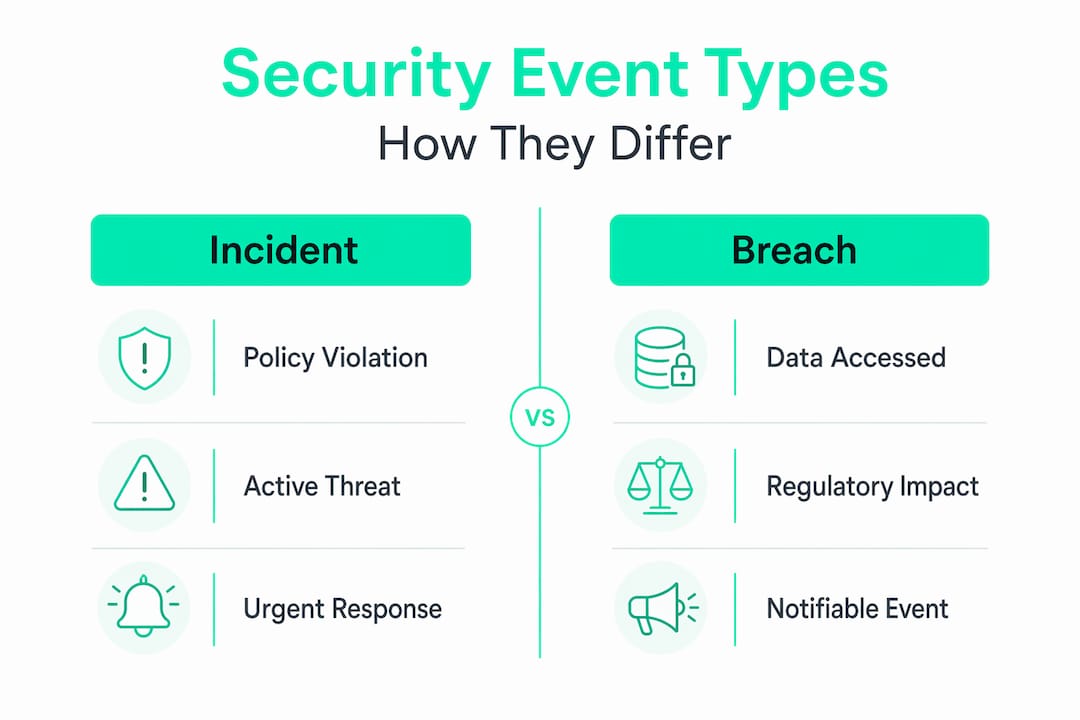
Pro Tip: Build a one-page decision tree for your team that walks through three questions: Does this event violate policy? Does it threaten confidentiality, integrity, or availability? Is there evidence of actual data access? The answers determine classification in under two minutes.
Common types and causes of security incidents
Understanding the types of security incidents your organization is most likely to face shapes everything from your defenses to your detection tools. The threat picture in 2026 is specific, and the data tells a clear story.
Vulnerability exploitation now accounts for 31% of confirmed breaches, overtaking credential abuse at 13%. That shift reflects how quickly attackers move on unpatched systems. The window between a CVE publication and active exploitation has collapsed to days in many cases.
The most common types of security incidents organizations encounter include:
- Unauthorized access. An attacker or insider gains access to systems or data they are not permitted to reach. This includes account takeovers and privilege escalation.
- Malware infections. Malicious software installs on a device or network, often through phishing emails, drive-by downloads, or compromised software updates.
- Ransomware attacks. A subset of malware where attackers encrypt files and demand payment. 31% of ransomware victims pay the ransom, with median payments sitting below $140,000.
- Insider threats. Employees, contractors, or partners who misuse access, whether intentionally or through negligence.
- Data exfiltration. Sensitive data is copied or transferred outside the organization, sometimes over weeks before detection.
- Social engineering. Attackers manipulate people rather than systems. Social engineering accounted for 16% of incidents in recent data.
What causes security incidents at the root level? The human element. 62% of breaches involve a human action, whether that is clicking a malicious link, misconfiguring a cloud bucket, or reusing a compromised password. Technology fails because people make decisions, and attackers know exactly how to exploit that. Training is not optional. It is the most direct line of defense against the most common attack vectors.
Implications of a security incident for organizations
Getting the classification right is not just an academic exercise. The moment you declare a security incident, legal clocks start ticking.

Under GDPR, organizations must notify supervisory authorities within 72 hours of becoming aware of a personal data breach. HIPAA requires covered entities to notify affected individuals within 60 days of discovering a breach. The SEC now mandates that public companies disclose material cybersecurity incidents within four business days. These timelines apply to breaches, not every incident. But here is the problem: misusing "security breach" and "data breach" interchangeably creates legal and operational confusion that triggers unnecessary disclosures or, worse, delays required ones.
The financial and reputational stakes are just as serious:
- Business disruption. Ransomware can halt operations for days or weeks. Manufacturing lines stop. Healthcare systems go offline. Revenue disappears.
- Regulatory fines. GDPR violations carry fines up to 4% of global annual revenue. HIPAA penalties reach $1.9 million per violation category per year.
- Reputation damage. Customer trust erodes fast after a public incident. Recovery takes years, not months.
- Cost of misclassification. Treating a minor incident as a breach wastes resources and triggers unnecessary public disclosure. Treating a breach as a minor incident invites regulatory penalties and litigation.
"The difference between a security incident and a data breach is not just semantic. It determines your legal obligations, your communication strategy, and your recovery timeline."
Precision in classification protects the organization. Ambiguity costs it.
How to handle a security incident
Security incident response is not a single action. It is a structured process, and the order of operations matters as much as the actions themselves. The standard lifecycle runs through six phases: preparation, detection and analysis, containment, eradication, recovery, and post-incident review.
Here is how to work through each phase effectively:
- Preparation. Document your incident response plan before anything happens. 77% of organizations lack formal incident response plans, which means they improvise under pressure. Improvisation amplifies damage. Define roles, escalation criteria, communication channels, and legal contacts in advance.
- Detection and analysis. Identify the incident using logs, alerts, and user reports. Classify it against your defined criteria. Clear escalation thresholds reduce alert fatigue and prevent delayed response to serious events.
- Containment. Stop the immediate damage without destroying evidence. This is where most teams make critical mistakes. Isolate affected systems from the network, but do not wipe them. Preserving volatile memory and forensic snapshots is the first rule of containment. You need that data to understand what happened and how far it spread.
- Eradication. Remove the threat. Patch the vulnerability. Delete malicious files. Revoke compromised credentials. Short-term containment stops immediate damage, but long-term containment removes adversary persistence. Conflating the two leads to reinfection.
- Recovery. Restore systems from clean backups. Validate integrity before bringing systems back online. Monitor closely for signs of recompromise in the first 48 to 72 hours.
- Post-incident review. Document what happened, what worked, and what failed. Update your plan. Share lessons learned across teams.
Cross-functional coordination is non-negotiable from step one. IT handles technical containment. Legal reviews communication before anything goes public. Communications manages stakeholder messaging. Leadership makes resource decisions. Running incident response as an IT-only function is one of the most common and costly mistakes organizations make.
Pro Tip: Never issue public statements or notify regulators before legal counsel reviews the language. A single poorly worded sentence can transform an incident into an admission of liability.
Real-world scenarios that illustrate the difference
Abstract definitions become concrete when you see them in context. Two scenarios show how the same principles apply across very different situations.
Scenario 1: Ransomware on cloud storage. An attacker gains access to an AWS S3 environment through a compromised IAM credential and begins encrypting files. The security team detects unusual API activity and declares an incident. The instinct is to delete the compromised IAM user immediately. That instinct is wrong. Deleting compromised IAM users destroys the audit logs needed to trace the attacker's path. The correct response is to apply explicit deny policies that restrict the user's permissions without deleting the account, preserving the forensic trail.
Scenario 2: Unauthorized access to HR records. An employee uses a colleague's credentials to access payroll data. Detection comes through an anomalous login alert. The incident response team:
- Isolates the affected account and resets credentials
- Pulls access logs to determine what data was viewed or copied
- Determines whether personal data was accessed, triggering breach notification assessment
- Escalates to HR and legal for disciplinary and regulatory review
- Documents the full timeline for post-incident reporting
The lesson from both scenarios is the same. Preparedness determines outcomes. Teams that have practiced these decisions make them faster and with fewer errors. Teams that have not make mistakes that compound the original damage.
My take on why incident classification gets mishandled
I've watched organizations respond to security incidents for years, and the pattern that frustrates me most is not the attackers. It's the internal confusion that turns a manageable incident into a crisis.
What I've seen repeatedly is that teams skip the classification step entirely. An alert fires, panic sets in, and everyone jumps to containment or, worse, public disclosure before anyone has confirmed what actually happened. That sequence destroys forensic evidence, triggers premature regulatory notifications, and burns through resources on threats that may not have materialized.
My honest take: most organizations do not have an incident classification problem. They have a communication problem. Nobody has agreed in advance on what words mean. "Breach" gets used when someone means "incident." "Incident" gets used when someone means "event." The vocabulary mismatch cascades into misaligned responses.
The fix is not complicated, but it requires deliberate effort before an incident occurs. Define your terms. Document your escalation criteria. Run tabletop exercises where your team practices classifying scenarios under pressure. The organizations I've seen handle incidents well are not necessarily the ones with the best technology. They are the ones whose teams have practiced the decisions so many times that clarity becomes instinct.
Evolving threats demand adaptability, but adaptability starts with a foundation. Get the fundamentals right first.
— Nick
Build your incident response skills with Cybercoreacademy
Understanding the theory behind security incident response is a start. Practicing it under realistic conditions is what actually prepares you.
Cybercoreacademy offers hands-on training through 77 modules covering phishing, malware, ransomware, insider threats, and more. You work through live attack simulations and make real decisions in realistic scenarios, not just read about what to do. Courses are structured around the same incident response lifecycle covered in this article, so the knowledge transfers directly to your work. Training starts at $10 per month, with a 3-day free trial. If you are serious about being ready when an incident hits, this is where to start building that readiness.
FAQ
What is a security incident?
A security incident is any event that violates security policy or threatens the confidentiality, integrity, or availability of systems or data. Not every suspicious event qualifies. The threat must be real and policy-relevant to be classified as an incident.
What is the difference between a security incident and a data breach?
A security incident is a broader category that includes any policy violation or CIA triad threat. A data breach is a specific type of incident where unauthorized parties have confirmed access to protected data. Fewer than 5% of incidents escalate to breaches.
What are the most common types of security incidents?
The most common types include unauthorized access, malware infections, ransomware, insider threats, data exfiltration, and social engineering attacks. Vulnerability exploitation is currently the leading breach vector, accounting for 31% of confirmed breaches.
How should an organization respond to a security incident?
Follow the six-phase incident response lifecycle: preparation, detection and analysis, containment, eradication, recovery, and post-incident review. Involve IT, legal, communications, and leadership from the start, and never wipe systems before preserving forensic evidence.
What causes most security incidents?
The human element drives the majority of incidents. 62% of breaches involve a human action such as clicking a phishing link, misconfiguring a system, or reusing a compromised password. Social engineering and unpatched vulnerabilities are the two most exploited entry points.