

Most cybersecurity professionals understand that responding to incidents matters. Fewer recognize that the incident response lifecycle explained properly is a continuous, cyclical framework, not a one-time reaction drill. If your team treats response as a linear checklist that ends at recovery, you're likely missing the phase that prevents the next breach. This article breaks down every stage of the incident management lifecycle, compares the NIST and SANS frameworks, and gives you the practical implementation and measurement guidance to run a program that actually improves over time.
Table of Contents
- Key Takeaways
- The incident response lifecycle, phase by phase
- NIST vs. SANS vs. ISO 27035
- How to implement incident response effectively
- Measuring your incident response program
- My take on what most teams get wrong
- Build IR skills that hold up under pressure
- FAQ
Key Takeaways
| Point | Details |
|---|---|
| Lifecycle is cyclical, not linear | Response is a continuous improvement cycle where lessons learned feed directly back into preparation. |
| Two dominant frameworks | NIST uses 4 phases while SANS uses 6; both are compatible and can be mapped onto each other for policy and operations. |
| Detection and identification differ | Detection spots an anomaly; identification confirms it as an incident and triggers full IR activation and scoping. |
| Eradication needs exit criteria | Teams must define measurable completion standards before moving to recovery to avoid reintroducing threats. |
| Metrics drive improvement | Time-to-detect, time-to-contain, and time-to-recover are the core indicators that reveal where your program needs investment. |
The incident response lifecycle, phase by phase
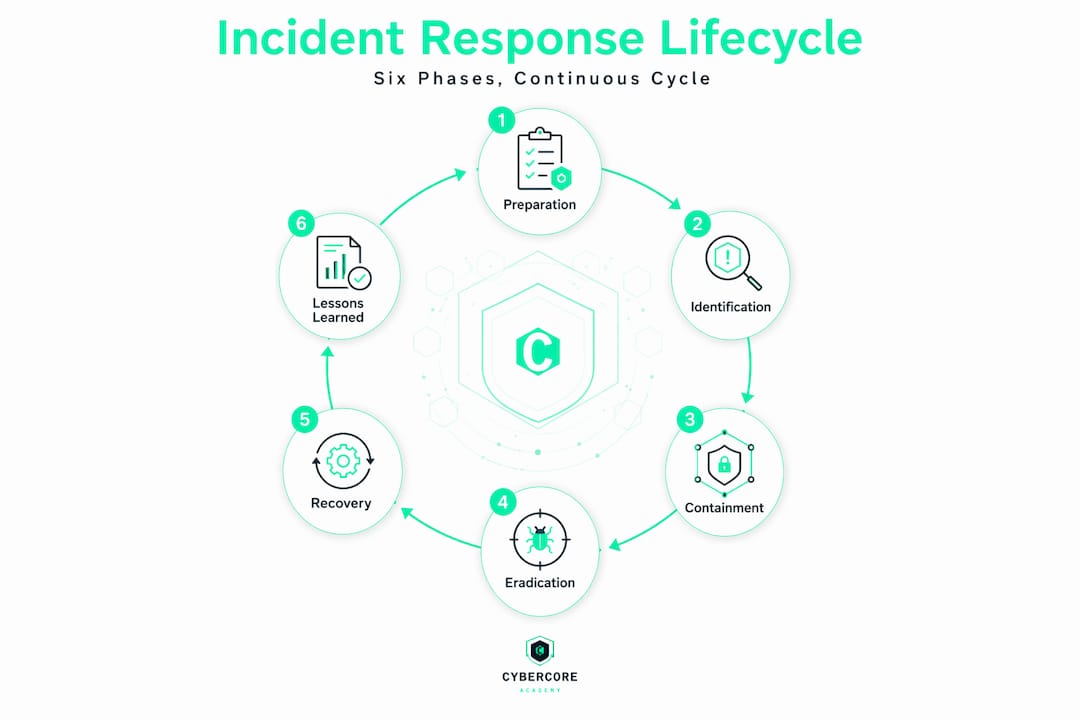
The standard 6-phase model that most security programs follow is known as PICERL: Preparation, Identification, Containment, Eradication, Recovery, and Lessons Learned. SANS popularized this model, and it remains the practitioner favorite for its operational granularity. Here is what each phase actually involves.
Preparation
This is the phase that determines how well every other phase goes. Preparation covers building your incident response plan, defining team roles, deploying detection tooling, running tabletop exercises, and establishing communication protocols. A team that skips preparation rehearsal will make expensive decisions under pressure that a rehearsed team handles in minutes.
Identification
Detection and identification are operationally distinct. Detection is your SIEM alerting on anomalous login behavior. Identification is the analyst decision that confirms this is a real incident, scopes the affected systems, and pulls the trigger on full IR activation. Treating them as one step collapses a critical decision gate.
Containment
Containment splits into short-term and long-term actions. Short-term containment stops the bleeding: isolate a compromised host, block a malicious IP, revoke a credential. Long-term containment involves more durable controls while the team works on root cause. A ransomware response, for example, might short-term isolate an entire network segment while long-term containment patches the entry point vector.
Eradication
This is where teams remove the threat entirely: delete malware, close backdoors, remediate misconfigurations, reset compromised accounts. The critical discipline here is defining measurable eradication criteria before you declare completion. If you cannot confirm the adversary no longer holds persistence, you will reintroduce the threat the moment you start recovery.
Recovery
Recovery restores affected systems to normal, verified operation. This includes restoring from clean backups, rebuilding compromised hosts, and validating system integrity before reconnecting to the production environment. The recovery phase is not "turn things back on." It is "confirm things are clean, then turn them back on."

Lessons learned
SANS recommends a formal after-action review within two weeks of incident closure. This review documents the timeline, identifies detection gaps, evaluates response quality, and produces concrete updates to playbooks, tooling, and training. Lessons learned is not optional debrief paperwork. It is the engine that feeds preparation for the next cycle.
Pro Tip: Document your incident timeline in real time during the response, not from memory afterward. Timestamps captured live are accurate; reconstructed timelines have gaps that make root cause analysis and reporting unreliable.
NIST vs. SANS vs. ISO 27035
Understanding where frameworks agree and differ saves you from framework paralysis. All three models cover the same conceptual territory. They differ in granularity and operational emphasis.
| Framework | Phases | Key characteristic |
|---|---|---|
| NIST SP 800-61 | 4 phases | Combines containment, eradication, and recovery into one phase; policy-focused |
| SANS PICERL | 6 phases | Separates each operational step; practitioner-focused with formal AAR requirement |
| ISO/IEC 27035 | 5 phases | Emphasizes governance, reporting, and improvement; compliance-oriented |
NIST's 4-step model combines containment, eradication, and recovery into a single phase because those activities genuinely overlap in real incidents. You might partially recover one system while still eradicating the threat on another. This reflects operational reality. SANS separates them because operationally, different team members own each step and need distinct exit criteria.
The practical approach is to map SANS phases onto the NIST framework so your organization maintains NIST policy alignment for governance and compliance while running the more detailed SANS procedures at the operational level. ISO 27035 adds formal reporting obligations and is particularly relevant for organizations operating in regulated industries or across multiple jurisdictions.
Pro Tip: Do not pick a framework and treat it as gospel. Use NIST for executive and policy-level documentation. Use SANS PICERL in your playbooks and analyst runbooks. The two reinforce each other.
How to implement incident response effectively
Theory without execution is just documentation. Here is how to translate the lifecycle into operational practice.
-
Build your preparation foundation first. Define your incident classification taxonomy (what is a P1 versus a P3?), assign incident response team roles (incident commander, technical lead, communications lead, legal liaison), and create playbooks for your highest-probability scenarios: ransomware, phishing compromise, credential theft, data exfiltration.
-
Instrument your detection pipeline. You cannot identify what you cannot see. Deploy endpoint detection, network monitoring, SIEM correlation rules, and cloud audit logging before an incident occurs. Define tuned alert thresholds so analysts spend time on real incidents, not noise.
-
Create decision gates between phases. Each phase transition should require explicit confirmation. Moving from containment to eradication requires documented evidence that spread has stopped. Moving from eradication to recovery requires confirmation of adversary removal. These gates prevent premature progression that lets threats persist.
-
Establish cross-team coordination protocols. Coordination across IT, engineering, and operations is one of the most consistently cited factors in managing incident complexity. Decide in advance who has authority to isolate a production system, who approves external communication, and who manages vendor escalation.
-
Run tabletop exercises quarterly. Reading a playbook is not practice. Run scenario-based exercises with your full IR team, including stakeholders outside the security team. Legal, HR, and communications teams need to know their roles before a real incident demands them.
Pro Tip: Treat your incident response plan as a living document. After every exercise and every real incident, schedule a 30-minute update review. Plans that go 18 months without revision are plans written for a threat environment that no longer exists.
The Canadian Centre for Cyber Security frames incident response not as a reactive task but as a repeatable organizational capability. That framing matters. A capability has owners, training schedules, budgets, and metrics. A task gets done when something breaks.
For organizations building their proactive security posture, understanding lifecycle implementation fundamentals provides a solid grounding in how preparation connects to every downstream phase.
Measuring your incident response program
You cannot improve what you do not measure. These are the metrics that actually reveal program health.
- Mean time to detect (MTTD): How long between an attacker gaining access and your team seeing the alert? This measures detection coverage and tuning quality.
- Mean time to acknowledge (MTTA): How long between alert firing and analyst assignment? This measures your triage process and staffing adequacy.
- Mean time to contain (MTTC): How long from confirmed incident to attacker activity stopped? This measures containment speed and playbook effectiveness.
- Mean time to recover (MTTR): How long from containment to full service restoration? This measures recovery process maturity.
- Repeat incident rate: Are you seeing the same attack vector succeed multiple times? This is the clearest indicator that lessons learned are not being acted on.
Standardized timeline event capture is what makes these metrics reliable. If analysts record events inconsistently, your MTTC calculations are meaningless. Define exactly what event timestamps to capture and where to log them before you need them.
Post-incident reviews are where these metrics feed into improvement. The review should answer: Why did detection take as long as it did? Where did the playbook fail? What tool or visibility gap allowed this? The answers drive updates to detection rules, playbooks, training, and tooling. That update cycle is what closes the loop from lessons learned back to preparation.
Treating post-incident reviews as a bureaucratic obligation rather than a diagnostic tool is where most programs stall. The review is not accountability theater. It is your most reliable source of threat intelligence about your own environment.
For organizations that want to benchmark their response metrics and improve their post-incident review process, building that discipline early pays compounding returns over time.
My take on what most teams get wrong
I have reviewed incident response programs across organizations ranging from lean security teams to enterprise SOCs, and the same failure pattern appears repeatedly. Teams invest heavily in detection tooling and playbook writing, then treat the lessons learned phase as a paperwork obligation they complete under time pressure and promptly file away.
The lifecycle does not improve through better tools alone. It improves through deliberate review. What I find more concerning is the absence of measurable exit criteria in eradication. Teams declare eradication complete when the obvious malware is gone. They do not confirm that all persistence mechanisms have been removed, all lateral movement paths have been closed, and all compromised credentials have been rotated. Then they move to recovery, reconnect systems, and the attacker walks back in through the door they left unlocked.
My honest recommendation: spend as much time designing your eradication checklist as you do designing your detection rules. The detection phase gets you into the incident. The eradication phase gets you out of it cleanly.
The other thing I consistently see underinvested is cross-team coordination. The technical response is usually competent. The breakdown happens at the boundary between the security team and legal, HR, communications, or executive leadership. Those handoffs need practice before they happen under pressure.
— Nick
Build IR skills that hold up under pressure
Reading about the incident response lifecycle is useful. Practicing it under simulated pressure is what builds real capability. Cybercoreacademy offers hands-on training built around exactly this gap.
With 77 modules covering live attack simulations, phishing response, malware analysis, and identity threats, Cybercoreacademy gives security professionals a structured environment to develop and test incident response skills before a real breach demands them. The platform uses scenario-based learning so you practice decision-making under realistic conditions, not just absorb theory. Certificates document your progress for employers and compliance requirements. Training starts at $10 per month, with a 3-day free trial. If you want your team ready for the next incident, not just trained for the last one, this is where that preparation starts.
FAQ
What are the main phases of the incident response lifecycle?
The most widely adopted model follows six phases: Preparation, Identification, Containment, Eradication, Recovery, and Lessons Learned. This is the SANS PICERL model, which includes a formal post-incident review feeding improvements back into preparation.
How does NIST's model differ from SANS?
NIST SP 800-61 uses four phases by combining Containment, Eradication, and Recovery into one phase. SANS separates these into three distinct steps with individual exit criteria, making SANS better suited for operational playbooks while NIST fits policy documentation.
Why is the lessons learned phase so important?
Lessons learned is the phase that converts incident experience into program improvement. Without it, teams repeat the same detection gaps, slow the same containment steps, and face the same threat vectors in subsequent incidents. It is the mechanism that makes the lifecycle genuinely cyclical.
What metrics should I track in an incident response program?
The four core metrics are mean time to detect, mean time to acknowledge, mean time to contain, and mean time to recover. These map to the four operational phases where team performance is most measurable and most improvable.
When should my team activate full incident response?
Full IR activation should occur at the identification phase, once an analyst confirms that an alert represents a real security incident rather than a false positive. Defining clear classification criteria in advance prevents both under-response to real threats and over-response to noise.