

Most teams sit through an annual security training video, click through a compliance quiz, and walk away no better prepared than before. When you conduct team cybersecurity awareness drills that simulate real pressure, real decisions, and real consequences, something different happens. Employees stop being passive recipients of information and start thinking like defenders. This guide covers exactly how to plan, run, and measure drills that actually change behavior, from setting up the right scenarios to closing the feedback loop after every session.
Table of Contents
- Key takeaways
- How to conduct team cybersecurity awareness drills: preparation essentials
- Running drills that actually engage your team
- Common mistakes that undermine security drills
- Measuring drill effectiveness and continuous improvement
- My honest take on why most drills miss the point
- Take your team's security readiness further
- FAQ
Key takeaways
| Point | Details |
|---|---|
| Broaden your participant list | Include HR, legal, and executives, not just IT, to expose real communication gaps. |
| Design for 2026 threats | Build scenarios around deepfakes and AI phishing to keep drills relevant and credible. |
| Use a no-blame culture | Frame every drill as system improvement so employees report mistakes instead of hiding them. |
| Follow up within 90 days | Document gaps, assign owners, and schedule a follow-up drill to build lasting resilience. |
| Reinforce with microlearning | Pair drills with frequent, short lessons to counter the natural forgetting curve. |
How to conduct team cybersecurity awareness drills: preparation essentials
Before you run a single scenario, you need a clear picture of what you are actually protecting and who needs to be in the room. Start with your organization's risk profile. Which systems are critical? What data would cause the most damage if compromised? A finance team faces different threats than a customer support team, and your drill scenarios should reflect that difference.
The most common mistake managers make is treating these as IT-only events. Cross-departmental gaps involving HR, PR, legal, and executives are often what cause real incidents to spiral out of control. Your drill participants should include the people who would actually be making decisions during a breach, not just the people who understand the technical side.
Here is what you need to gather before your first session:
- Realistic scenarios tailored to your industry and threat profile
- A designated facilitator who can guide discussion without giving away answers
- A communication plan so participants know the drill is a drill (and when it is not)
- Time blocks appropriate to each audience (executives need shorter, sharper sessions)
- A post-drill debrief template to capture observations while they are fresh
| Material | Purpose | Owner |
|---|---|---|
| Scenario scripts | Drive the exercise narrative | Security lead or facilitator |
| Inject timeline | Simulate escalating crisis events | Facilitator |
| Participant role cards | Clarify each person's decision scope | HR or team lead |
| Debrief template | Capture gaps and action items | Manager or security lead |
| Communication plan | Notify stakeholders before and after | Communications or HR |
One framing decision shapes everything else: tell your team from day one that this is about improving your systems, not catching people making mistakes. Positive reinforcement for reporting concerns builds a culture where people speak up instead of covering up. That shift alone is worth the cost of the drill.
Pro Tip: Send a brief pre-drill survey asking participants what cyber threats they feel least confident handling. Use those answers to shape your scenario design and show employees their input actually matters.
Running drills that actually engage your team
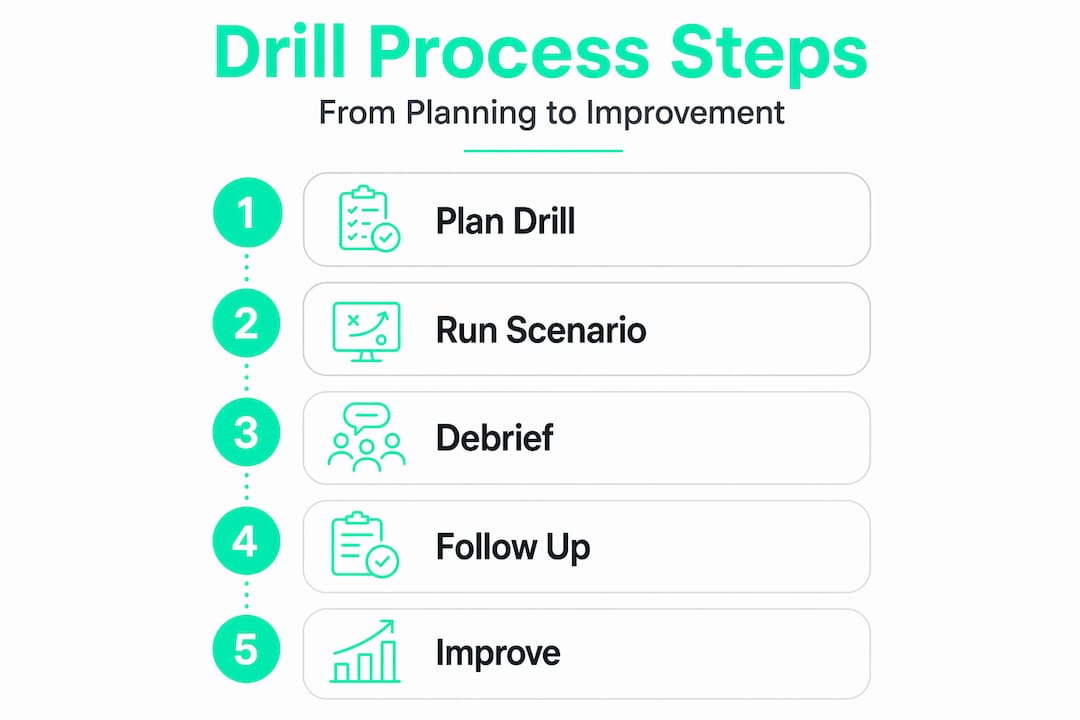
Once your preparation is solid, execution is where most managers either win or lose their team's attention. The goal is to create a working session, not a lecture. Facilitators guide timed injects that simulate how a real crisis evolves, pushing participants to apply their incident response plans under realistic pressure.
Here is a practical format that works across most organizations:
- Open with context (5 minutes). Briefly describe the scenario setting without revealing the full threat. Give each participant their role card and remind everyone this is a judgment-free session.
- Deliver the first inject (10 minutes). Present the initial threat signal, such as a suspicious email flagged by an employee or an unusual login attempt. Ask: "What do you do right now?" Let the discussion run without interrupting.
- Escalate with a second inject (10 minutes). Add a complicating factor. Maybe the CEO's credentials appear compromised, or a vendor reports a related breach. Watch how communication flows across departments.
- Introduce a deepfake or AI phishing element (10 minutes). The FBI reported a 100% increase in deepfake fraud reports between 2023 and 2025. Your 2026 scenarios need to include these threats to stay credible.
- Force a decision point (5 minutes). Ask the group to decide: contain, escalate, or communicate externally? Assign ownership of each decision out loud.
- Debrief immediately (10 minutes). What worked? What broke down? Where did communication stall? Write it down before anyone leaves the room.
For executive stakeholders specifically, a 20 to 30 minute format works best: five minutes for scenario overview, ten minutes for discussion, and five minutes for decision-making and assigning ownership. Executives disengage fast when sessions run long, so respect their time and they will respect the process.
Gamification helps with broader staff sessions. Leaderboards, team scoring, and small recognition for the first correct identification of a threat signal turn a drill into something people actually want to participate in. Competition reveals who your natural security advocates are, and those people become your internal champions.
Pro Tip: Pre-test technical access for cloud consoles and audit tools at least one week before the drill. Nothing kills momentum faster than spending the first 15 minutes troubleshooting login issues.
Common mistakes that undermine security drills
Even well-intentioned managers run drills that fall flat. Knowing the failure patterns in advance saves you from repeating them.
- Keeping it inside the IT team. When only technical staff participate, you miss the communication failures that actually cause incidents to escalate. Legal needs to know when to notify regulators. HR needs to know how to handle an insider threat. These conversations only happen if those people are in the room.
- Running sessions that are too long. A two-hour drill for a mixed audience is a recipe for disengagement. Break complex scenarios into focused 30 to 45 minute blocks with clear objectives for each.
- Skipping logistics checks. Forgotten access credentials, missing scenario documents, and broken video links all signal to participants that leadership does not take this seriously. Preparation reflects priority.
- Using a punitive tone. If employees fear being singled out for wrong answers, they stop engaging honestly. The research is clear on this: framing testing as system improvement rather than employee fault fosters trust, increased reporting, and long-term behavior change.
- Running one drill and calling it done. A single annual exercise is not a security culture. It is a checkbox.
"Security awareness training is shifting toward continuous, adaptive models leveraging AI to keep content relevant amid fast-moving threats and diverse role-based risks." — Security Awareness Training Enters the Agentic Era
Scenario relevance is another quiet killer. If your finance team is running through a scenario about a server room intrusion, they will tune out. Keep role-based content specific. A phishing scenario for accounts payable looks very different from one targeting your IT administrator, and both should feel like something that could actually happen to that person tomorrow.
Measuring drill effectiveness and continuous improvement
The drill ends when the debrief ends. Everything after that is where the real value gets built or lost.

Start by capturing observations immediately. Assign someone the job of note-taker during the drill, not after. Document every gap, every hesitation, every moment where communication broke down. Organizations gain lasting value by documenting findings, updating plans promptly, assigning remediation owners, and scheduling follow-ups within 90 days.
Set measurable behavioral metrics so you can track progress over time. The numbers that matter most include:
- Phishing click rates before and after drill cycles
- Reporting frequency (how often employees flag suspicious activity)
- Time to escalation during simulated incidents
- Decision accuracy under inject pressure
Phishing simulations reduce click rates by an average of 40% within 12 months when used for coaching rather than punishment. That is a measurable outcome you can report to leadership.
Pro Tip: Send a one-page summary to all participants within 48 hours of the drill. Include what went well, what needs work, and the three specific actions your team will take before the next session. Transparency builds buy-in for future drills.
Here is a quick comparison of drill formats and their follow-up priorities:
| Drill type | Best for | Key follow-up action |
|---|---|---|
| Tabletop exercise | Leadership and cross-functional teams | Update incident response playbooks |
| Phishing simulation | All staff | Coaching sessions for those who clicked |
| Red team inject | Security and IT teams | Patch identified gaps within 30 days |
| Role-play scenario | Department-specific teams | Revise role cards and communication trees |
Microlearning is the connective tissue between drills. Humans lose roughly 70% of new information within 24 hours without reinforcement. Short, frequent lessons delivered through Slack or Microsoft Teams keep security top of mind without adding to training fatigue. Think of drills as the high-intensity workout and microlearning as the daily movement that keeps the habit alive.
My honest take on why most drills miss the point
I have seen organizations invest real money in cybersecurity training exercises and still get breached because the training never changed how people actually behaved under pressure. The problem is not the content. The problem is the culture surrounding the content.
When I look at teams that genuinely improve their security posture after conducting security drills, the common thread is not the sophistication of the scenario. It is whether employees felt safe enough to admit what they did not know. That only happens when leadership models the behavior they want to see. If your CISO admits they would have fallen for that deepfake in the drill, everyone else feels permission to be honest too.
My experience shows that involving cross-functional teams almost always reveals a communication failure that nobody knew existed. Legal does not know who to call. The communications team has no approved breach statement. The CEO does not know the containment protocol. These are not IT failures. They are organizational failures, and no amount of technical controls fixes them.
I also think the obsession with annual compliance events is genuinely counterproductive. Microlearning modules integrated into daily workflows reduce training fatigue and improve retention far better than one long session per year. The goal is a team that thinks about security every day, not a team that passes a test once a year.
Pair your drills with technical resilience measures like immutable backups. Human awareness and technical controls are not competing priorities. They are the same defense strategy working at different layers.
— Nick
Take your team's security readiness further
Running effective team security awareness sessions is only half the equation. Your team also needs a place to practice the skills those drills reveal they are missing.
Cybercoreacademy gives your employees hands-on experience through live attack simulations across 77 modules covering phishing, malware, AI threats, and identity protection. Every scenario mirrors real-world conditions, so the decisions your team makes in training are the same decisions they will make when it counts. The platform includes gamified leaderboards and XP to keep engagement high, plus certificates that give employees tangible proof of their progress. Plans start at just $10 per month, with a 3-day free trial so your team can experience the difference before committing.
FAQ
What is the ideal length for a cybersecurity awareness drill?
For executive stakeholders, a focused 20 to 30 minute session works best. Staff-level drills can run 45 to 60 minutes when broken into structured injects with clear discussion prompts.
How often should you conduct security drills?
Most security experts recommend at least quarterly drills for cross-functional teams, supplemented by monthly microlearning and periodic phishing simulations to maintain behavioral readiness between sessions.
Who should participate in cybersecurity awareness drills?
Beyond IT and security staff, drills should include HR, legal, communications, and executive leadership. These roles make critical decisions during real incidents and need practice handling them under pressure.
How do you measure whether a drill was effective?
Track phishing click rates, employee reporting frequency, and time to escalation before and after each drill cycle. Phishing simulations used for coaching can reduce click rates by 40% within 12 months.
What is the biggest mistake managers make when running security drills?
The most common mistake is limiting participation to technical teams and skipping the debrief. Without cross-functional involvement and documented follow-up, drills reveal nothing and change nothing.