

Most organizations already know that people are the weakest link in their security posture. What they struggle with is building a program that actually changes behavior rather than just checking a compliance box. Getting the enterprise security awareness program components right requires more than scheduling annual training and calling it done. 68% of breaches involve human error, and AI-driven threats are raising the stakes further. This article breaks down what a modern, effective program actually looks like in 2026.
Table of Contents
- Key takeaways
- Core enterprise security awareness program components
- Seven essential components of an effective program
- Traditional vs. agentic security awareness approaches
- Situational recommendations for tailoring your program
- My take on what most programs get wrong
- Build a program that actually works with Cybercoreacademy
- FAQ
Key takeaways
| Point | Details |
|---|---|
| Human error drives most breaches | Building behavior-focused components is more effective than purely technical controls. |
| Policy documentation is foundational | A written security awareness and training policy defines accountability and sets program expectations. |
| Phishing-only programs are outdated | Modern programs must cover AI threats, deepfakes, and social engineering beyond email. |
| Measurement enables improvement | Benchmarking phishing click rates and behavior metrics lets you allocate resources where they matter most. |
| Culture beats compliance | Positive reinforcement and no-blame reporting cultures outperform shame-based approaches in reducing risk. |
Core enterprise security awareness program components
Before you build anything, you need a framework for deciding what belongs in your program. Not every organization faces the same risk profile, and not every training format produces the same results. The criteria below help you evaluate which cybersecurity program elements deserve priority.
Alignment with your risk profile and compliance requirements. CCPA regulations under sections §7123(c)(12) and §7123(c)(13) formally separate cybersecurity awareness from documented training, treating them as distinct audit components. That distinction matters when you are designing your program architecture. Know which regulations govern your organization before you assign content.
Coverage breadth across the modern threat surface. Programs focusing solely on phishing are leaving significant exposure unaddressed. Your content must span password hygiene, AI-enabled impersonation, prompt injection risks, shadow AI usage, and incident reporting procedures. A narrow program creates a false sense of security.
Dynamic delivery over static content. Annual slide decks do not change behavior. The most effective awareness training strategies use microlearning, short video bursts, and simulations that adapt to current threat intelligence rather than content written 18 months ago.
Measurable behavioral outcomes. Completion rates tell you nothing meaningful. Track phishing click rates, incident report volume, and post-training assessment scores over time. If you cannot measure it, you cannot improve it.
Stakeholder buy-in and leadership visibility. Programs that lack executive sponsorship get treated as optional by employees. Leadership participation in training signals that security is a cultural priority, not an IT formality.

Pro Tip: Avoid training fatigue by keeping individual modules under 10 minutes. Short, frequent sessions consistently outperform long quarterly marathons in both retention and engagement.
Seven essential components of an effective program
These are the building blocks every security professional should have in place. Think of them as a checklist you can audit against your current program.
1. Engaging, threat-current content. Your content library must reflect what attackers are doing right now. 90% of organizations recognize that AI threats increase training importance, yet only 40% of leaders believe their workforce is actually prepared. That gap closes when content covers deepfakes, AI-generated phishing, and prompt injection, not just legacy email scams.
2. A formal written policy. Written security awareness policies are the foundation of any program that survives leadership turnover or a regulatory audit. The policy should define who is responsible for program delivery, what training is mandatory, how often it occurs, and what consequences apply for non-completion. Without this document, your program has no spine.
3. Regular, adaptive security training modules. Short, frequent, and engaging training sessions consistently outperform infrequent long-form training in retention and behavior change. Build a cadence of monthly microlearning modules with quarterly deeper dives. Adapt content based on what your simulations and incident data are telling you about where employees are struggling.
4. Phishing and social engineering simulations. Simulations are where awareness becomes skill. Run campaigns that mirror real-world lures, including voice phishing (vishing), SMS phishing (smishing), and AI-generated spear phishing. Vary the difficulty and frequency so employees stay sharp without feeling targeted.
5. Embedded incident reporting processes. Reporting a suspicious email should be frictionless. If employees need to search for a reporting button or fear being blamed for clicking, they will stay silent. Embed one-click reporting tools directly in the email client and make the process feel like a contribution, not a confession.
6. Measurement and benchmarking frameworks. Benchmarking phishing click rates over time gives you hard evidence of program effectiveness. One well-documented case shows click rates dropping from 31.4% to 4.8% over 12 months of consistent training. Track behavior metrics by department, role, and tenure to identify where your program needs reinforcement.
7. A no-blame reporting culture. Public shaming in phishing simulations damages trust and actively reduces incident reporting. When employees fear embarrassment, they hide mistakes rather than report them. Build positive reinforcement into the program. Recognize employees who report correctly and treat simulation failures as learning moments, not performance issues.
Pro Tip: Tie simulation results to coaching, not discipline. Employees who click a simulated phishing link should receive immediate, helpful feedback, not a manager notification.
Traditional vs. agentic security awareness approaches
The way programs deliver training has changed significantly. Here is how the two dominant models compare.
| Factor | Traditional approach | Agentic (AI-enabled) approach |
|---|---|---|
| Content updates | Manual, often months behind current threats | AI-driven weekly updates aligned to live threat intelligence |
| Personalization | Generic, role-agnostic delivery | Adapts to individual behavior, risk profile, and learning pace |
| Simulation realism | Templated scenarios with limited variation | Dynamic simulations generated from real-world attack patterns |
| Engagement | Higher fatigue from repetitive content | Reduced fatigue through varied, contextually relevant content |
| Resource demand | Lower upfront cost, higher manual maintenance | Higher initial investment, lower ongoing maintenance burden |
| Best fit | Smaller organizations with limited budgets | Mid to large enterprises with complex threat surfaces |
The confidence gap is where agentic models prove their value most clearly. Up to 80% of employees report confidence in detecting threats but fail realistic practical tests. Static training reinforces that false confidence. Agentic systems expose it by generating simulations employees have not seen before, forcing genuine skill development rather than pattern recognition.
That said, agentic models are not automatically better for every organization. If your workforce is small and your threat surface is narrow, a well-maintained traditional program with strong facilitation can still perform. The decision should come down to your threat complexity, budget, and whether your team has the capacity to maintain content manually.
Situational recommendations for tailoring your program
No two organizations face identical risk environments. These adjustments help you match components to your specific context.
High-risk industries (healthcare, finance, critical infrastructure). Increase simulation frequency to monthly. Require role-based training modules that address sector-specific threats like medical device exploits or wire fraud schemes. Compliance-driven training is the floor, not the ceiling.
Remote and BYOD workforces. Employees working on personal devices or home networks face risks that office-based training often ignores. Add modules covering home network security, secure VPN usage, and the risks of mixing personal and work applications. Role-based training for remote workers should address the specific ways attackers exploit that environment.
Executives and privileged users. C-suite employees are high-value targets for spear phishing and business email compromise. They also tend to receive exemptions from standard training programs, which is exactly the wrong approach. Build targeted modules that address executive-level attack scenarios and make participation non-negotiable.
Budget-constrained organizations. Prioritize the components with the highest risk reduction per dollar spent: phishing simulations, a written policy, and a clear incident reporting process. These three alone will outperform a bloated program that employees ignore. Platforms like Cybercoreacademy offer structured training at accessible price points without sacrificing content quality.
Compliance-first environments. If your program is driven primarily by regulatory requirements, map each component explicitly to the relevant control framework. Document everything. Regulators want evidence that training occurred and that it was effective, not just that you scheduled it.
My take on what most programs get wrong
I have seen a lot of security awareness programs across organizations of every size, and the most common failure is not a lack of budget or technology. It is a lack of honesty about what the program is actually trying to do.
Too many programs are built around phishing because phishing is measurable and easy to simulate. That focus creates blind spots. Modern programs must cover deepfakes, prompt injection, and shadow AI risks. If your employees can spot a phishing email but have no idea what a deepfake voice call sounds like, your program is solving yesterday's problem.
The second mistake I see constantly is using simulation failures as a gotcha. I have watched organizations publicly post department-level click rates in all-hands meetings, thinking it creates accountability. What it actually creates is a culture where people hide mistakes. The research is clear: positive reinforcement cultures reduce risk far more effectively than shame-based approaches.
The third issue is leadership exemption. When executives skip training, every employee notices. Security culture is set from the top. If the CISO is not completing the same modules as the rest of the organization, the message employees receive is that training is for other people.
What actually works is treating the program as a continuous feedback loop rather than an annual event. Run simulations. Measure results. Update content. Repeat. The organizations that do this consistently see measurable behavior change within 12 months.
— Nick
Build a program that actually works with Cybercoreacademy
If you are serious about putting these components into practice, the platform you choose matters as much as the strategy you design.
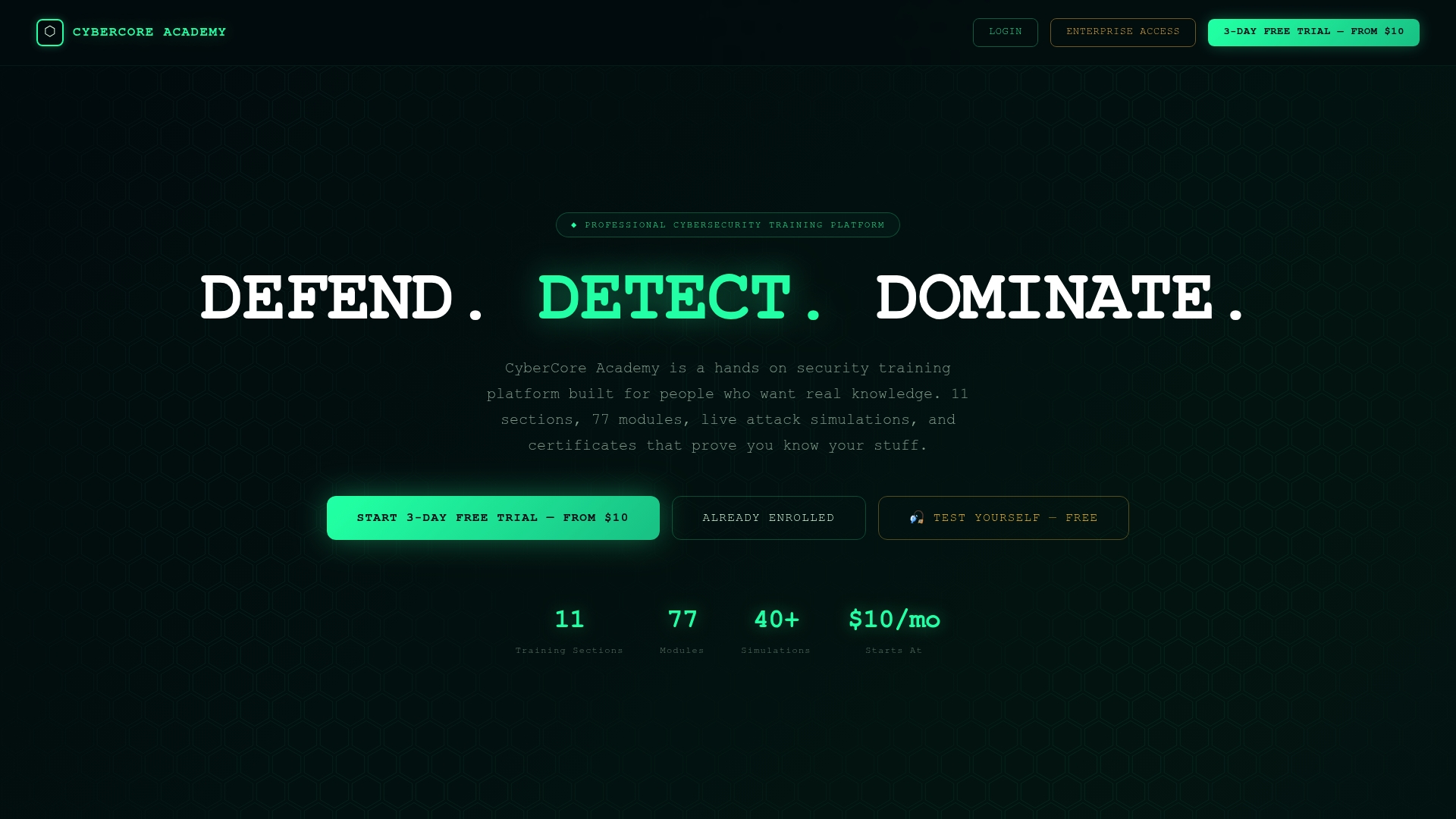
Cybercoreacademy is built around exactly the kind of hands-on, behavior-focused training that modern enterprise security awareness programs require. With 77 modules covering phishing, malware, AI threats, and identity protection, the platform goes well beyond checkbox compliance. Live attack simulations put employees in real decision-making scenarios rather than passive slide reviews. The gamified structure with XP and leaderboards keeps engagement high without requiring constant manual facilitation. Certificates provide documented proof of completion that satisfies audit requirements. Pricing starts at $10 per month, with a 3-day free trial so your team can evaluate fit before committing.
FAQ
What are the core components of an enterprise security awareness program?
The core components include a formal written policy, role-based security training modules, phishing and social engineering simulations, an incident reporting process, and a measurement framework for tracking behavior change over time.
How often should security awareness training occur?
Monthly microlearning sessions combined with quarterly deeper training and ongoing phishing simulations produce the best results. Annual-only training is insufficient given how rapidly threats evolve.
What is the difference between security awareness and security training?
Security awareness builds general knowledge about threats and risks, while security training develops specific skills and behaviors. CCPA regulations treat these as distinct program components with separate audit requirements.
How do you measure the effectiveness of a security awareness program?
Track phishing simulation click rates, incident report volume, and post-training assessment scores over time. Consistent benchmarking allows you to identify high-risk groups and measure improvement, with well-run programs showing click rates drop from over 30% to under 5% within a year.
What makes agentic security awareness training different?
Agentic training uses AI to generate personalized simulations and update content dynamically based on current threat intelligence, replacing static content that can be months out of date. This approach directly addresses the confidence gap where employees feel prepared but fail real-world tests.